PDF is the digital world's most ubiquitous data container; however, moving this data securely onto a blockchain creates a cryptographic bottleneck. zkPDF, developed by the PSE (Privacy Stewards of Ethereum) team, is an infrastructure project designed to solve this problem using a zkVM (Zero-Knowledge Virtual Machine) approach.
In this article, we will examine zkPDF’s technical architecture, verification flow, and current limitations from an engineering perspective.
The Technical Problem: Data Integrity vs. Privacy
As a developer, when you want to verify a user-submitted PDF document (e.g., a bank statement), you are faced with two suboptimal choices:
- Backend Verification: You upload the file to your server. (❌ Privacy Violation: You see all the data.)
- Client-Side Signature Check: You verify the signature in the browser. (❌ Trust Issue: The result can be manipulated; no on-chain proof is generated.)
ZKPs (Zero-Knowledge Proofs) enable "verification without revealing data." However, processing the complex structure of a PDF format (compression, stream objects, metadata) within a ZK circuit is impractical due to the massive computational overhead.
Solution Architecture: zkVM as a Notary
Instead of embedding the PDF parsing logic directly into a circuit, zkPDF executes this process inside a zkVM.
The system flow is as follows:
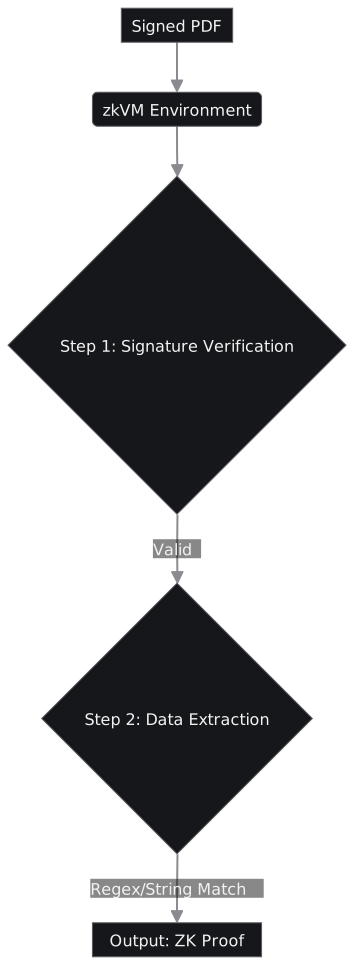
Module 1: Signature Validator
This is the gateway to the system. It analyzes the digital signature of the PDF.
- Function: Verifies the document's
integrityand sourceauthenticity. - Library Used: The project's
signature-validatormodule. - Supported Algorithms: Currently supports PKCS#7/CMS based structures:
- SHA-1, SHA-256, SHA-384, SHA-512 with RSA
Module 2: Extractor
Once the signature is verified, the parser within the zkVM activates.
- Method: Uses Regex or exact string matching to locate target data.
- Selective Disclosure: For example, instead of revealing the whole document, it generates an output proving only the proposition
income > 50000. - Code: The
extractormodule manages this parsing process.
Standards and Compatibility
For a developer, knowing which files can be processed is critical. zkPDF relies on ETSI standards.
| Standard | Technical Structure | Support Status |
|---|---|---|
| PAdES (PDF Advanced) | The signature blob is embedded inside the PDF structure (ByteRange). | ✅ Primary Goal |
| CAdES (CMS Advanced) | The signature is a detached .p7m file separate from the original. |
⚠️ Partial Support / WIP |
| XAdES (XML Advanced) | XML-based signature structure. | ❌ Not Supported |
Note: If you are planning an integration, ensure your system generates PAdES (embedded signature).
Technical Limitations (Trade-offs)
Here are the bottlenecks you need to be aware of for production use cases in the current architecture:
1. Client-Side Proving Cost
Generating a ZK proof for multi-megabyte PDF files on mobile devices or browsers is still prohibitively expensive in terms of memory and CPU.
- Current State: Proof generation is generally performed on a Prover Network (server-side).
- Privacy Risk: Even if encrypted, the data travels to the prover server. For total privacy, Client-Side Proving is essential, and optimization efforts (memory management, folding schemes) are ongoing.
2. Regex Complexity
Locating data within a PDF via regex is heavily dependent on the document's structure (font encoding, whitespace). There is a high probability of parser errors with PDFs created in non-standard ways.
Next Steps for Developers
If you want to build a PoC (Proof of Concept) with this technology:
- Review the Repo: github.com/privacy-ethereum/zkpdf
- Focus Areas:
- Client-side Proofs: Experiment with browser-based proof generation.
- Universal Parsing: Parser improvements to standardize outputs from different PDF generators (Adobe, iText, etc.).
- Contribute: The project is open source, and optimizations are specifically needed in the
signature-validatormodule.
Summary: zkPDF is a bridge that transforms "signed data" into "verifiable data." Although still in the early stages, it holds the potential to become a significant primitive in the ZK Application Layer.